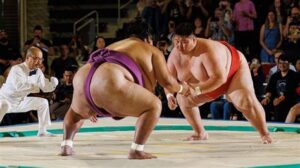
 Let’s be honest: to most Westerners, sumo wrestlers are larger-than-life cartoons: gargantuan men wearing something resembling thong bikinis who do nothing but swagger and push each other around. But a recent trip to Japan has taught me that there’s much more to this iconic Japanese sport. It is a highly competitive, full-contact wrestling match in which a rikishi attempts to force his opponent out of a circular ring or into touching the ground with any body part other than the soles of his feet. Strength, balance, endurance and strategy are all on display. And while any given match can last only a few seconds, the sport itself stretches back to the beginning of time.
The reverence for strength in battle originated in Japan’s mythological period, known as “The Age of the Gods.” Around four hundred BCE, when rice was first cultivated in the country, sumo was incorporated into the native Shinto religion and practiced as a prayer ritual to ensure a good harvest. (Even now, the traditional clay circle in which the wrestlers compete, called a “dohyo,” is considered a sacred space.) 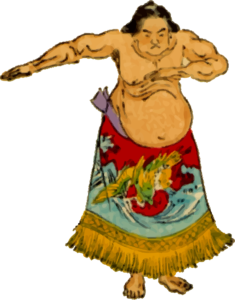 Sumo evolved into an activity of the ruling elite, and during the height of the Samurai period (the twelfth through sixteenth centuries), it became part of a warrior’s training regimen.
 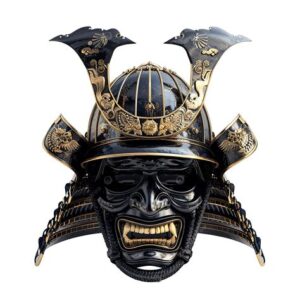 In fact, the distinctive hairstyle worn by sumo wrestlers today is a carryover from the sport’s Samurai past (Warriors bundled their hair on top of their head to provide a cushion for their heavy helmets). Eventually, the Samurai culture died out, but sumo lived on as an entertainment for the masses, which it remains today.
Joining the ranks of sumotori as a rikishi is like becoming a professional athlete in any other sport: it takes natural talent and years of hard work, yet few make it to the top. Aspiring fifteen- to sixteen-year-old boys who have performed well in local sumo or judo matches are analyzed by scouts (No, they don’t look for overweight kids!). Aside from a powerful build, ability to focus, and a burning desire to compete, wrestlers must be at least five foot eight inches tall. (One ambitious young man actually had a plate inserted at the top of his head to gain the fraction of height he needed!) 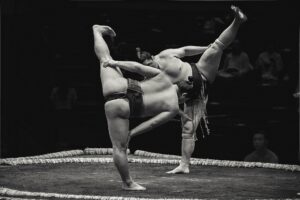 The average professional rikishi is around six feet tall and weighs two hundred fifty to four hundred pounds, although surprisingly, there are no weight categories or restrictions for the athletes. The smallest sumo wrestler on record weighed only one hundred thirty-two pounds, while the largest tipped the scales at six hundred forty-five pounds. Imagine those two facing each other in the ring!
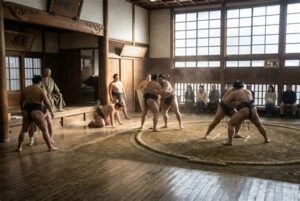 If selected, the teens join a training facility, called a “heya,” (“room” or “stable” in English) where they are financially supported, live communally and follow a strict daily regimen. They’re up at 5 a.m. to clean, cook and perform other chores. Then they train for four hours before eating an unbelievable eight to ten thousand calorie meal. After lunch, they sleep. The evening meal? It rivals lunch. Imagine consuming as much twenty thousand calories per day! The training phase can last years, until the young wrestler is deemed ready to enter his first tournament.
You would think a lot of junk food goes into the making of a sumo wrestler. Nope. Those calorie-laden meals are designed to build muscle and use plenty of lean protein, mainly in the form of chicken, fish and tofu. Trainees eat little beef and pork because tradition says that cows and pigs need all four feet to maneuver, thus they are not as powerful as chickens, who need only two feet to face their enemies. It’s all about power (but it helps that chicken is a particularly healthy protein.)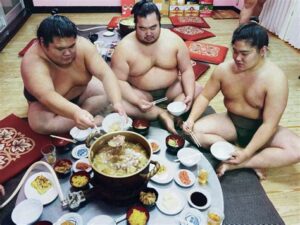
A staple for sumo wrestlers is a soup/stew called Chanko nabe, made with vegetables like cabbage, mushrooms, and daikon; chicken meatballs, miso broth and noodles or rice. I haven’t made it yet, but it sounds delicious. Recipes vary, but you can learn how to make a popular version of Chanko nabe HERE.
Sumo tournaments are held six times a year: three in Tokyo (where most of the stables are), and one each in Osaka, Nagoya and Fukuoka. The tournaments last about two weeks, as wrestlers compete to improve their win/loss ratios and move up in the standings. There are six levels of competition, the highest being the Makuuci and the Juryo. The top seventy athletes who inhabit these levels are called the Sekitori and they get much more than bragging rights. In addition to thousands of dollars in monthly income, the Sekitori get perks like personal attendants, their own room at the stable, and no more chores. They also claim the right to wear a special silk loincloth and participate in certain tournament rituals. Best of all, they’re finally able to get married! And, if they make it to the top of the heap, so to speak, they become a Yokosuma, a Grand Champion. Once they attain that title, it can never be taken away, even if they lose subsequent matches. There have been only seventy-five Yokosumas since 1909, when the level was officially established. 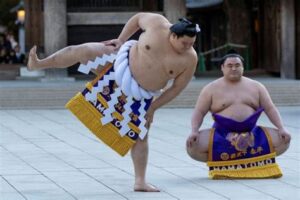 These superior athletes (such as Grand Champion Onosato, left) are the equivalent of rock stars in Japan.
Wearing next to nothing in the training ring and the tournament dohyo is both a spiritual and a practical matter. The loincloths, called mawashi, are made of cotton or silk, and vary depending on the wrestler’s rank. 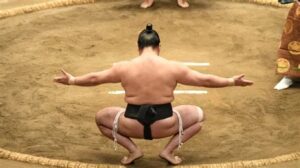 The practice is a nod to the Shinto tradition of being open and honest with the gods. It’s difficult to hide a weapon if you’re practically naked! The mawashi serves a strategic purpose, too, because it enables the wrestler to move as freely as possible, while giving his opponent something to grab onto.
Because of its Shinto roots, Sumo wrestlers follow a prescribed series of movements at the beginning of each day’s tournament that honor the gods (known as kami), purify the surroundings and ensure that matches are fought fairly and respectfully.
Before an individual match, opponents will scatter salt (believed to have purifying powers) over the dohyo to cleanse the ring of negative energy and safeguard themselves from injury. 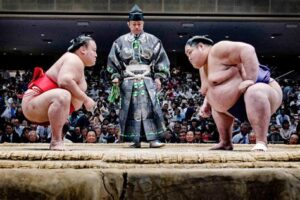 They will then attempt to intimidate each other by squatting and staring each other down. They’ll clap their hands to draw the attention of the gods, stomp their massive legs to drive away evil spirits, and spread their arms wide to show they are unarmed and ready to compete fairly. The ritual is twofold: to appease the gods and to ramp up tension and excitement for the match. But spectators better pay attention because the match itself can be over in the blink of an eye.