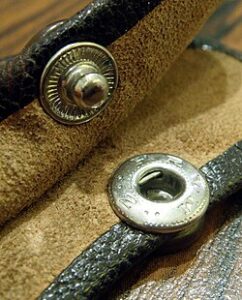
 Snaps. Those little interlocking disks (originally called “spring button closures”) that make fastening clothing a “snap” were the brainchild of several inventors in close succession: Heribert Bauer of Germany in 1885, with Bertel Sanders (Denmark), Albert-Pierre Raymond (Switzerland) and Myra Juliet Farrell (Australia) all submitting their own versions of the innovation about the same time.
  Initially considered a novelty closure for men’s trousers, the easy-to-use snaps soon found a home with the military and ranchers, both of whom needed something snag-proof and faster to use than buttons. It wasn’t until 1946 that garment maker Jack Weil put snaps on cowboy dress shirts, which led to a fashion trend that persists today. Yee haw!
https://www.backthenhistory.com/articles/the-history-of-snap-buttons
https://en.wikipedia.org/wiki/Snap_fastener
Photo credit: Pixabay (Cheryl Holt) and Wikipedia.
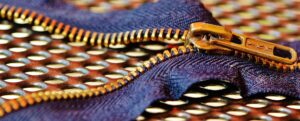 Zippers. Elias Howe, Jr., inventor of the sewing machine, had an idea for an “Automatic, Continuous Clothing Closure” which he patented in 1851. It went nowhere (probably because of the name). In 1893 another inventor, Whitcomb Judson, brought the “Clasp Locker” to market, so he got credit for being the father of the device, even though his version didn’t do well either (it’s the name, I’m sure of it).
 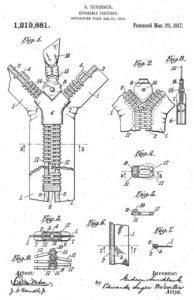 Twenty years later, the head designer of Judson’s Universal Fastener Company, Gideon Sundback, finally turned the founder’s flawed idea into the zipper we all know and love. But even he couldn’t get the name right. Not until 1923 did the B.F. Goodrich Company call its new rubber boot fastener a “zipper,” based on the sound the fastener made. My poor characters had no idea (at least in 1907) that such a revolutionary method of quickly closing tops, pants, skirts, dresses – well, just about anything we wear – was just around the corner.
https://www.thoughtco.com/history-of-the-zipper-4066245
Photo credit: Pixabay (AlexasFotos) and WikimediaCommons
 Velcro. Funny how an afternoon in the countryside can change the course of fashion history. In 1941, Swiss engineer George de Mestral went hunting in the Alps; afterward, when brushing his dog’s fur, he noticed that burrs clung to both his pants and the dog. Turns out the burrs consisted of thousands of tiny hooks that under a microscope looked like “a monster’s mouthful of spiked fangs.”
 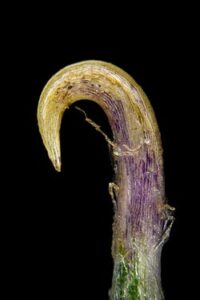 De Mestral figured he could create a clever fastening system from the concept but it took ten years of trial and error to find the right material (nylon) and manufacturing process to get it right. He called his invention “Velcro” a combination of the French words velour (“velvet”) and crochet (“hook”).
  Velcro was patented in 1955 and originally used by the aerospace program because it was a lot easier for astronauts to use while wearing gloves. Today we use it to easily fasten all sorts of clothing, from head to toe.
https://www.history.com/articles/velcro-invention
https://en.wikipedia.org/wiki/George_de_Mestral
Photo credit: Pixabay (FotoRieth and Jackmac34) and Wikipedia
 Magnets. Magnets have been around for thousands of years. Legend has it that a Greek shepherd, minding his flock in Magnesia, got the nails in his shoes (or could have been his iron staff) stuck to a rock that was later named magnetite. In the modern era, many substances with magnetic properties have become indispensible to virtually every industrial and medical field. But their application to clothing occurred as late as 2012, with the introduction of “Maggie’s Snaps,” which attached clothing without using pins, knots or sewing. Since then, magnets have been used increasingly in accessories like purse clasps and jewelry.
 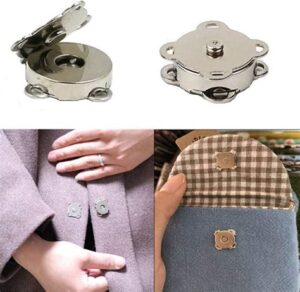 They also factor into what’s called “transformational” fashion, in which a few articles of clothing can turn into an entire wardrobe just by strategically moving magnets around the garments.
  Imagine putting a month’s worth of high fashion outfits into a European-size carry on – if only!
https://www.mymaggies.com/pages/the-maggies-story
https://www.fashionstudiesjournal.org/longform/2018/9/15/transformable-fashion
Photo credit: Vastsky Magnet, gosupps.com