From food and housing to transportation and entertainment, every historical period has details that distinguish it. Since my mysteries take place in turn of the twentieth century America, I have to dress my characters a certain way: 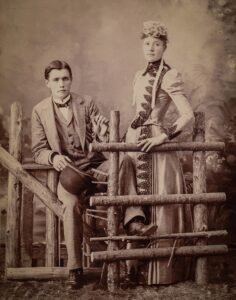 Men, depending on their social status, usually wore vests and bowler hats; women most often suffered through cinched waists and long skirts (not to mention the unmentionables underneath). But how did all those articles of clothing hold together compared to previous epochs? And what do we use today that they didn’t?
You may file this post under “Amusing but useless information,” but I found it interesting, so here’s a primer (pronounced “primmer” in this context) on fasteners over time:
 Laces. There’s no record showing precisely when the first human figured out that a strip of hide from the animal he’d killed, and whose fur he wore, could be used to keep the pelt from falling off. By studying lice genetics (who knew?), anthropologists estimate that humans, being hairless primates, began wearing garments to stay warm anytime between 83,000 and 170,000 years ago. One can imagine they used ties in any number of ways,
 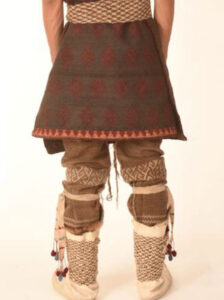 from keeping their pants up (just kidding—the first record of pants has only been traced back to 1200 BCE in China) to carrying their favorite knives and clubs. One thing is certain, though: leather shoelaces go back to at least 3500 BCE because they were found on the shoes of the oldest human mummy discovered in Europe, “Otzi the Iceman.” That 1991 discovery is amazing, considering that leather typically starts to disintegrate in under a century.
https://www.stumpcrosscaverns.co.uk/prehistoric-fashion-what-did-stone-age-people-wear
https://eameigs.substack.com/p/from-skin-to-clothing-how-early-humans
https://www.ancient-origins.net/news-history-archaeology/oldest-trousers-0016468
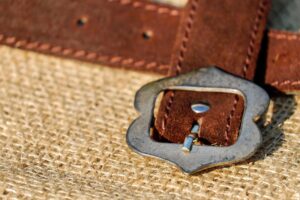 Buckles. This simple method of attaching two ends of something using a metal clasp (most often used in belts today) has been around for thousands of years, and was a staple of ancient Chinese, Greek and Roman civilizations.
 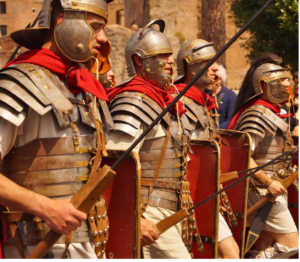 Regular people used buckles to keep their robes and tunics from flapping too much, but they were particularly useful for soldiers, who used them to keep their armor in place and their weapons organized. Over time they were proudly displayed to denote rank. https://bucklemybelt.com/blogs/news/the-evolution-of-belt-buckles-through-history
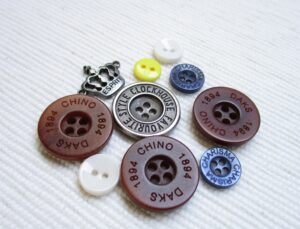 Buttons. The earliest known buttons were discovered in the Indus Valley (a region including parts of Pakistan, India and Afghanistan) and date back at least four thousand years. Surprisingly, they weren’t used to fasten anything; made of curved shells with little holes, they were used to decorate a garment. Not until the thirteenth century did buttonholes appear, which means clothiers in Europe and the Middle East finally figured out that buttons could connect two pieces of clothing quite nicely. For several hundred years thereafter, the production of buttons was highly regulated and only the upper classes were allowed to wear them in abundance. Fortunately, the Industrial Revolution opened the market to the masses.
 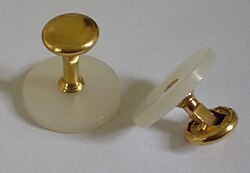 Over time, variations on buttons, such as collar studs and cufflinks, defined men’s fashions, but eventually women incorporated them in all colors, shapes and sizes and for all purposes. In addition to holding clothing together, they’re back to their original purpose of embellishing outfits just because they look cool.
https://www.thecreativecurator.com/clothes-fastenings/
https://www.thecreativecurator.com/different-types-of-buttons/
The History of Underclothes by C. Willett Cunnington and Phyllis Cunnington
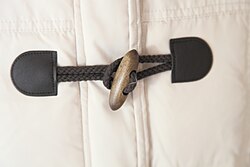 Toggles. Those small wooden or metal rods that connect two sides of something by means of a looped cord have been around in Europe since the Iron Age (800 BCE to 400 CE.), but they began to function as clothing fasteners during the Medieval Period. Over the next few centuries they gained popularity, particularly among the military set.
 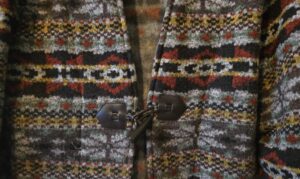 They’re not as common today, but they do make a fashion statement, usually fastening jackets, coats and purses with aplomb.
https://archaeologyandconservationcardiff.wordpress.com/2020/06/12/tiny-beauties/
Pins. Pins have been used since antiquity as both adornments and to fasten clothing; in fact, they have quite a sinister past. According to the Greek historian Herodotus, who lived in the fifth century BCE, several Athenian women who used long “dagger like” pins to fasten their tunics, ganged up on a very unlucky soldier and stabbed him to death. No doubt they had good reason to go to such extremes, but afterward, the style of tunic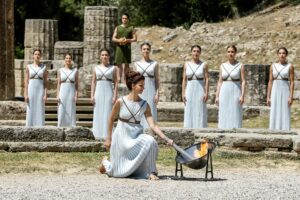 they’d worn was outlawed. A much less lethal version of the pin was invented in 1849 by American engineer Walter Hunt. Today, few women can deny using a safety pin at some point to re-attach an article of clothing that needed a quick (and hidden) fix. Thanks, Walter!
https://museumofeverydaylife.org/current-exhibitions/a-visual-history-of-the-safety-pin
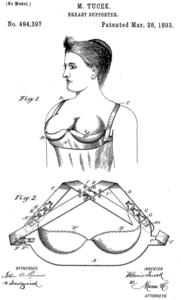
 Hooks and Eyes. Some people insist that hooks and eyes are a modern convenience invented in the 19th century in the United States. It’s true that many enterprising Americans patented methods to manufacture and use them, not the least of whom was Marie Tucek, whose 1893 innovation, the “Breast Supporter,” used hooks and eyes in a way that’s still popular today (Thanks, Marie!).
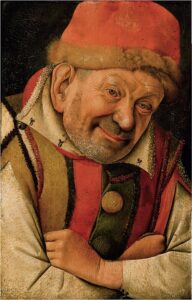
  Historically, however, a reference to this style of fastener first appeared in 14th century England, and a hundred years later, hooks and eyes were showing up all over Europe. The proof of this can be found in a 15th century painting by French artist Jean Fouquet of a court jester, Pietro Gonnella, who clearly displays them on his collar. Even the Virgin Mary used them, as depicted in a late 15th century painting by Franceso Bianchi. Clearly hooks and eyes were used as both stylish and practical fasteners way back then.
https://www.selvedge.org/blogs/selvedge/hook-and-eyes
[Photos via Pixabay, Wikimedia Commons and me.]
Next time: all the fasteners my cast of characters in early San Francisco didn’t have access to … but we do.