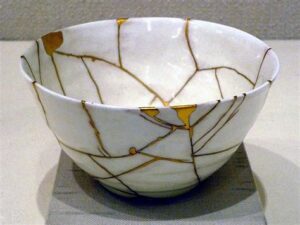
 Even before I traveled to Japan, I was intrigued by the ceramic art form known as Kintsugi, which literally translates to “golden joinery.” On the face of it, the concept doesn’t make sense: If you break something, you’d just throw it out, right? It will never look the same again; why not just replace it, or at the very least hide it from others? If it’s not “whole” and perfect, it’s not worth using.
Legend has it that trying a different approach to brokenness originated in the fifteenth century, when shogun Ashikaga Yoshimasa (he of the wealthy warrior class) broke his favorite Chinese tea bowl. Supposedly, he sent the bowl back to China to be repaired, and when he got it back, he was shocked to see it was hideously cobbled together (Frankenstein comes to mind, even though that monster made his debut four centuries later).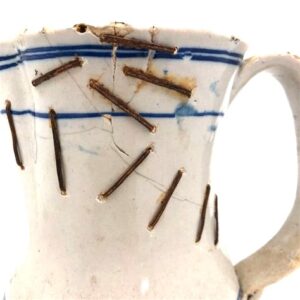 Yoshimasa figured there had to be a better way, so he set his own craftsmen to work, and they hit upon putting the shattered bowl back together with veins of gold. Thus, kintsugi was born. Today, antique kintsugi pottery can sell for thousands of dollars; even contemporary kintsugi art pieces, depending the artist, can command hefty prices. With the right touch, a simple bowl or vase can be purposely destroyed and “reborn” into something much more beautiful than its original form.
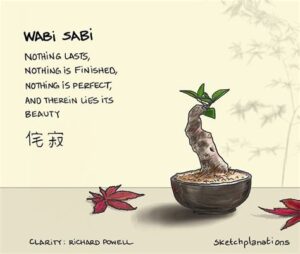 Kintsugi is revered in Japan because it exemplifies the concept in Japanese aesthetics known as wabi-sabi, which embodies Buddhism’s three marks of existence, often described as impermanence, suffering, and interconnectedness. This philosophic view embraces such ideas as asymmetry (the opposite of “balance”), simplicity, roughness, modesty, the force of nature, and one concept many of us can relate to: visible signs of aging!
What appeals to me most about kintsugi as an expression of wabi-sabi is the idea that an imperfection isn’t something to feel bad about or hide, but something to acknowledge and find something positive about.
Let’s say you made a mistake in your life and it’s held you back from being your best self. You keep beating yourself up about whatever it is, even though it happened in the past.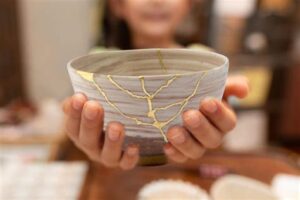 Wabi-sabi says, why not accept the mistake, appreciate it for what it can teach you, and use what you’ve learned to make yourself a better individual than you were before? Kintsugi is a great symbol of that transformation.
The steps for creating kintsugi pottery are straightforward, but not easy. I attended a kintsugi workshop in Osaka, and they had it down to a science, but at home, it takes a lot more effort:
- Gather the pieces of pottery that you’ve either broken accidentally or broken on purpose in order to create an original piece of art. Make sure the pieces aren’t too small; three or four are plenty.
- Glue the pieces back together. Traditional kintsugi artisans use urushi lacquer that comes from the sap of a tree related to poison ivy. Unless you’re a purist, you might want to use another glue because urushi needs a lot of humidity to work well and takes a long time to set. Experiment with various products like Super or Gorilla Glue to find what works best for the type of material you’re putting back together. (Note: you can buy the various elements for the process online. Amazon carries lots of them; simply look for “Kintsugi Repair Kit.”)
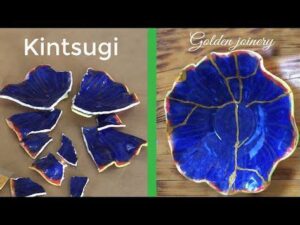
- Fill in the gaps that might have resulted from a pottery shard or two that you can’t easily glue back into place. Traditionalists use urushi mixed with powdered clay or stone. The result might be some wider veins throughout your piece, but that’s okay.
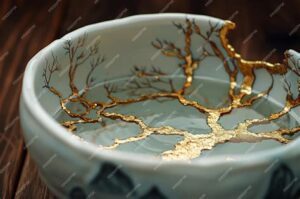
- Once your piece is thoroughly dry and feels sturdy, paint the seams with gold, silver or platinum powder. Some people not only turn the cracks into golden or silver seams, but add decorative elements on parts of the object that weren’t even broken.
- Following the instructions for whatever embellishment you’re using, file and/or polish the veins so they shine like precious metal.
A word of caution: this process is not easy; I have tried it on several occasions and found it takes patience and a willingness to experiment. Even so, I think the metaphor works well, because as we all know, it’s not easy to work through mistakes we’ve made, to get to the point where we can honestly say whatever we went through made us a better person in the end.
Let me know if you decide to create your own kintsugi masterpiece and send me a pic at ab@abmichaels.com. I look forward to seeing how you turned something broken into something beautiful!